10 Ideas to Increase Distance Learning Engagement

Whether we’re back in school full time in September or in some sort of hybrid model, we’re going to need to address the elephant in the room – engagement. Students will have a difficult time adjusting to either model after 3 months of remote instruction in the spring. There will be plenty of challenges but the only pieces I can control are my curriculum and my instruction. Both can go a long way to improving engagement, so here is my top 10 list for building engagement in the “new normal.”

  1. Build relationships with students. Students are more engaged and work harder for teachers they like and for teachers they think like them. Get to know them informally. Chat. Get to know them formally with guided bellringers and focused conversations.
  2. Maintaining a regular routine will make the transition back to school easier for students which will make it easier for them to engage. Begin every class period with a bellringer. Have a few minutes of direct instruction, then a few minutes of independent or group investigation or experimentation and end with a closure that brings it all back home. Surprises are fun, but routine is more accessible for students.
  3. Provide choice. Students perform better when they have some control over what they do. When my daughter first started having an opinion about the clothes she wore, maybe age 2, it would take hours of debate and struggle for her to choose an outfit from her closet, and often it was not an appropriate outfit for the occassion or weather. Instead of giving her the entire closet to choose from, I gave her the choice of 2 or 3 outfits that were equally appropriate. Use this in your classroom. Provide choice, but not unlimited choices. Give students control and they will perform better.
  4. Digitize as much as possible. Obviously, that addresses the need for flexibility since we seem rudderless for September. Expect the best but prepare for the worst. But digital resources are more engaging for students, especially since shared hands on resources will likely be banned. Digital resources are also flexible for hybrid situations. Hyperdocs and digital labs also save paper, so win-win 🙂
  5. Allow your students to work in groups. We’re receiving direction that there is to be no sharing of materials and that students must remain socially distant. But that doesn’t mean they can’t cooperate on a shared Google doc to create a product. They can share data and observations during labs digitally. They can partner together in Zoom breakout rooms.
  6. Gamify your classroom. I’ve always used games in my classroom – they are naturally engaging and motivating for students – but we’re going to need to arrange for games that don’t use shared resources. Kahoot, here we come! I’ve always been a big fan of escape rooms – I love the Breakout.edu resources and have a ton of locks and boxes that make the kids’s eyes light up – but I’m moving toward digital escape rooms this year.
  7. Provide brain breaks. The age and temperament of your students will determine how often and what type of brain break you should use, but I think it’s going to be more important now than ever.
  8. Engage with phenomena. The NGSS have long proposed that phenomenon based instruction boosts engagement. Present students with a photo or a demo of something to pique their curiosity.
  9. Be present. If we’re remote, live lessons are more engaging than video lessons but video lessons are more engaging than worksheets.
  10. Provide meaningful feedback quickly. When a student submits work, they should obviously receive a grade, but, more importantly, they should receive guidance on how to improve next time. Imagine receiving a mediocre report on your observation. “Fine,” you think and forget it. But if it included specific strategies to improve next time, you’d be more inclined to include those strategies in your lessons to improve your score.


Photo by National Cancer Institute on Unsplash

Energy Sources PBL

Students are more engaged and learn more when they participate in a problem based activity compared to a more traditional classroom activity. To teach energy sources, I use a PBL that is adaptable for independent or group work and is adaptable for in school instruction and for remote learning.

To begin this PBL, students learn that they have inherited an island. It is huge – large enough for literally anything they can imagine.

Here’s where you hook them. Let them dream big – water parks, luxurious spas, golf courses, amusement parks, hotels, restaurants, movie theaters.

Then, students have to figure out how to provide energy to support all of the activities they want to include.

This will work as a summative assessment after teaching energy sources, but it can also be a springboard to engage students into learning about the different energy sources so they can make an informed decision.

Provide research materials about the energy sources you want your students to learn about. I opted to allow them to choose from petroleum, hydroelectric power, solar power, and wind power, so I provided them with hyperdoc research documents. For some students, Google is a great resource. For middle school students, I find that guided research is more productive.

After learning about the different types of energy, students outline the pros and cons of using each type on their island. What’s the best economically? Which is most readily available? Which is going to produce the least pollution? Which will be the least unattractive for guests?

Finally students create a SlideShow with a drawing of their island and a persuasive paragraph explaining why they chose the energy source they chose.

To modify this, you could increase the requirement to a 5 paragraph essay for students who need more of a challenge, or provide a template for students who need more support.

While you’re teaching energy sources, try a free renewable and non-renewable energy scavenger hunt! It’s a great way to get kids up and moving and learning the vocabulary of alternative energy. Read more here.

Designing a Hybrid Unit

Last week I hypothesized that schools would be moving toward hybrid schedules – in person instruction some days and remote or distance learning other days. The challenge is to cover the same content in less contact time. This is a unit I designed on atomic structure.

What do I want to accomplish? On paper, I’m addressing NGSS  MS-PS1-1 – Develop models to describe the atomic composition of simple molecules and extended structures. In reality, I’m teaching students how to determine how many protons, neutrons, and electrons an atom has and how to represent that atom as a Bohr model and as a Lewis dot structure.

Day 1: In person instruction. What is an atom? What do they look like? What are the subatomic particles? How many subatomic particles are in an atom? As usual, I teach this using a Google SlideShow as my anchor with cloze notes for students. I prepared the cloze notes as a hyperdoc that students can complete on their Chromebooks during class or at home if we change to fully remote instruction.

Day 2: Remote or distance learning. Students will accomplish two things on this day. First, they will practice calculating protons, neutrons, and electrons so that we can move on to drawing atoms tomorrow. Secondly, they will do some research into the development of the atomic theory in a choice board.

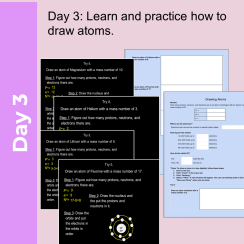
Day 3: In school instruction. Continuing with my SlideShow and cloze notes, I’ll teach how to draw a Bohr model of the atom. Because it’s possible (probable?) that some students (if not all) will be doing this remotely, I made the cloze notes completely digital so I included instructions on how to use Google Drawings and add it to the notes.

Day 4: At home remote/distance learning. Practice drawing Bohr models of atoms using hyperdocs.

Day 5: In school instruction on valence electrons and Lewis dot structures of atoms using a Slideshow and hyperdoc cloze notes. Finish the lesson by drawing Lewis dot structures of the first 18 atoms and hopefully identifying the pattern of valence electrons in the periodic table.

Day 6: At home review of all concepts in an escape room type of activity.

On Day 7, students would be assessed on what they’ve learned.

If schools adopt this one day in, one day out strategy, curricular materials can be assigned either in class if teacher assistance is required or for remote learning if students can manage on their own.

What unit have you started modifying?

Moving to Hybrid Learning

No matter how you slice it, my classroom in September will not look like any previous Septembers. I don’t know if we’re going to be completely digital, completely in person with 6 foot distances and masks, or some kind of weird hybrid/chimera situation.

The two hybrids I saw floating around are daily hybrids – half of the kids in school on odd days, the rest in on even days – and weekly hybrids – half of the kids in one week and the other half the week later. I’m not going to belabor the pros and cons of each of these models – I’ll leave that to the muckety mucks – but I have to get my groove on and start planning.

Let’s assume there’s going to be a hybrid situation. That means that I’m covering the curriculum in person twice – once with each half of my students. While they’re not with me, they need to have standards based curricular content that they can work with. The home time has to continue to move the curriculum forward, or else I only cover half of the curriculum all year.

Sounds alien? No. We’ve been doing it all along. We used to call it “Flipped Learning” and “Station Model.” Now we’re calling it “Hybrid.” Same stuff, different day.

Let’s imagine we’re on a daily hybrid situation. Day 1 – students in class. Day 2- students working on materials at home (while I’m doing Day 1 with the other half of the kids). Day 3- back in school. Day 4 – back at home.

A good general format might be:

  • Day 1 – in school – introduce concepts, do an introductory lab, teach new skill.
  • Day 2 – at home – learn and practice vocab, write lab analysis, practice skill.
  • Day 3 – in school – group activities or discussions, whole class review, another lab.
  • Day 4 – at home – assessment.

The trick to planning, I think, is separating which activities must be done in school from the activities that can be done at home and then sequencing them so that students will have learned the requisite skills and concepts before they have to practice them at home.

If we move to a week by week hybrid, perhaps the plan is:

  • Week 1 – in school – introduce concepts, do labs, teach skills, review.
  • Week 2 – at home – practice vocab and skills, write lab analysis, take assessment.

Again, the most challenging piece to teachers is going to be ensuring that students have learned the skills and concepts before they go home. Another challenge with the weekly hybrid is that teachers will be working double duty – monitoring home students and assisting as needed more frequently than if the rotation was daily. Imagine the student who practiced a skill wrong for an entire week – you’ve got to catch the mistakes early before they become irreversible.

Here’s a first draft of hybrid lessons I designed for my atomic structure unit. I’d love your feedback. In the mean time, let me know what your school is thinking.

Building relationships

The name of the game in middle school is building relationships. Students learn more from teachers that they feel a connection with.

It’s important to teach standards based content. But it’s more important to teach students. Which is why I include relationship building into my lesson plans.

Every Friday, the normal Bellringer for my middle schoolers is a Group Chat. I call it Face to Face Friday. As each student walks in, I hand them a card with a question on it. Depending on the class size, there might be 4 or 5 different questions – enough for a group of 5-6 students to all get the same question. Questions include “Would you rather…” kinds of questions as well as more open ended questions. I might purposefully put 2 students together, or purposefully separate 2 students, if my antennae are picking up anything that needs adjusting.

The first thing students must do is find the other people with the same question. If you color coordinate the cards, it’s easier. Then, I set the timer for 3 minutes while they discuss their answers. Finally, each group chooses a reporter to share their answer with the class. One rule I’ve implemented is that no one can be a reporter two weeks in a row. I don’t bother policing that – students do it for me.

As students discuss their questions, we learn a little bit about them. Sure, we learn thing like “Would you rather eat ice cream for every meal or not at all?” but we also learn how they communicate, how they express agreement and disagreement, and how they take turns. We help them navigate working with different students every week. We help them manage developing interpersonal relationships within the confines of a structured activity.

How do you encourage students to build relationships?

Skills you should have by now

It’s the end of June. We’ve been in a worldwide pandemic for more than 3 months. You should have mastered these skills by now:

  1. Wearing a mask. It helps protect you and it helps protect others. It’s not rocket science, but the sooner we all stop passing the virus around, the sooner we can return to life as we knew it. Cover your nose and mouth.
This is how you do it. Key points to notice: nose and mouth are covered. Eyes are not.

2. Mute yourself when you’re not talking on Zoom and unmute yourself when you are talking. Come on, folks. This is now a basic life skill. Figure it out.

What’s making you crazy this month?

Photo cred: original photo and license

3 Great Science Podcasts

When I’m going for a jog or cooking dinner or sewing masks, I like to listen to podcasts. I have a bunch of favorites, but the 3 I want to talk about today are really super for science teachers. They provide great content that I can always find ways to incorporate into my lessons.

  • 60 Second Science by Scientific American – Almost daily, this podcast delivers something newsworthy in less than a minute. Nice to keep up on science news, but also nice to peruse the archives for specific topics.
  • Science Rules! with Bill Nye – Everyone’s perennial favorite science teacher, Bill Nye brings in experts on many fields to answer the questions that listeners ask. Episodes drop irregularly but average about once a week. The last few months have been dedicated to the science of coronavirus but scroll back in the archives for in depth discussions on topics as varied as regeneration, memory, Einstein, vitamins, GMOs, and a ton of others, all told in the user friendly approachable style Bill Nye is famous for.
  • Science vs – This is my new favorite. Host Wendy Zukerman is very entertaining as she examines a topic every week and presents data on both sides of the issue before drawing a conclusion. Like Bill Nye, this podcast dedicated a few months to coronavirus coverage but the archives include topics like police shootings, DNA kits, getting more sleep, 5G, vaping and vaccines.

Try them out and let me know what you think!

Climate Change in Middle School Science

New Jersey is the first state in our Nation to incorporate climate change into its K-12 learning standards. Effective for the 2021-22 school year, the new standards apply to Health/PE, Science, Social Studies, Technology, Visual/Performing Arts, and World Languages. Here are some tools to incorporate climate change into your middle school science curriculum to incorporate the new climate change standards.

School districts, some still working remotely, have  until September, 2021, to incorporate this change into their curricula.

Of course, most middle school science teachers are already teaching climate change as some component of their curriculum. I talk about climate change in my decomposition unit because decaying organisms release carbon dioxide and methane, both of which are greenhouse gases. I’ve also taught climate change as a stand-alone unit. This year, that stand-alone climate change unit was followed by a quick lesson an alternative/renewable energy and then a series of hyperdocs on petroleum and renewable energy sources

Scientific literacy and the ability to think critically about items in the news is an important component of being a contributing member of society and it often falls to middle school science teachers to begin to build those skills. Climate change sometimes falls into the category of politically dividing and your students may have their own charged opinions about the issues based on what they believe.

Neil deGrasse Tyson is credited with saying “Science is true whether you believe it or not.” It’s our job to make sure that students learn to separate science from opinion. When I’ve heard students say they “don’t believe in climate change,” I’ve responded, “It’s not like the tooth fairy.” Believing isn’t what’s important – understanding climate change is what matters here. Incorporating climate change into middle school curricula will help build the understanding that students can use to separate fact from opinion.

In anticipation of this curricular change I imagine we’re all going to be looking for hands-on climate change activities. I’ll race you to Pinterest!

Tips and tricks to incorporate climate change standards into middle school science curricula

Solar System Travel Brochure

Before you go on a vacation, you need to know about the place you’re going, right? You need to know what kind of weather to expect, what the accommodations are, what activities there are to do. Get students hooked on learning about the solar system by telling them they’re going to take a vacation to another planet.

Now, they need to learn about the planets. This could be research-based or whole class lecture or group work.

And once you’ve got them excited about the planets, have them pick the one that’s most interesting to them. Let them tell you why – is it the rings? Is it the moons? The storms or the thick atmosphere? Then, let them convince you to go there on vacation. Encourage them to use all the creativity they can – maybe there is a rollercoaster in the craters of Mercury or an excursion to Enceladus.

s

With this assessment, a teacher can see how well a student understands the characteristics of one planet. But, possibly more importantly, a teacher can measure how well a student can apply what they’ve learned about a planet to a new situation, which might be more revealing about the student’s skills. As an added bonus, this assessment adds in some core content standards as well 🙂

What do you think about this assessment? Would it work for your students?


As extra practice, try a magic picture reveal digital worksheet! As students get more answers correct, the pixels of the picture are revealed one by one. Very engaging, and easy to implement digitally! Watch a preview video of the solar system magic picture reveal digital worksheet here.