Teaching climate change in middle school is both an opportunity and a challenge. Students are naturally curious about the world around them, but climate science can feel abstract, data-heavy, and emotionally charged. As teachers, we need lessons that are accurate, engaging, age-appropriate, and standards-aligned—without requiring endless prep time.
That’s exactly why I created the Climate Change 3-Week Unit for Middle School, a comprehensive, ready-to-teach curriculum designed to help students understand climate science step by step. In this post, I’ll walk you through daily lesson plans for all three weeks, explain how each activity builds understanding, and show you how to integrate free climate change resources from the blog to strengthen your instruction.
👉 View the full 3-Week Climate Change Unit here:
https://www.teacherspayteachers.com/Product/Climate-Change-3-week-Unit-for-Middle-School-13554276
👉 Grab the free climate change slides and notes here:
https://justaddh2oschool.com/2025/05/17/kickstart-your-climate-change-unit-with-these-freebies/
Why a 3-Week Climate Change Unit Works in Middle School
Climate change is not a single lesson topic—it’s a system of connected ideas. Students need time to build background knowledge, analyze data, and explore solutions. A multi-week approach allows students to move beyond memorization and toward scientific reasoning, evidence-based thinking, and real-world application.
This unit is designed to:
- Support NGSS middle school climate standards
- Balance hands-on activities, digital resources, and discussion
- Scaffold complex ideas like the carbon cycle and greenhouse effect
- Encourage critical thinking without overwhelming students
WEEK 1: Climate Science Foundations
Week 1 focuses on building core understanding. Students learn what climate is, how it differs from weather, and how Earth’s systems regulate temperature.
Day 1: Weather vs. Climate
Objective: Students will distinguish between weather and climate using examples and data.
Begin with a short bell ringer asking students to describe today’s weather. Most will list temperature, rain, or wind. Then ask: Is that climate?
Using guided notes and visuals, introduce the difference between short-term weather patterns and long-term climate trends. Students work collaboratively to sort examples (daily temperature vs. 30-year averages) into categories.
This lesson sets the foundation for the entire climate change unit and prevents one of the most common misconceptions students have.
Assessment: Exit ticket explaining the difference in one clear sentence.
Day 2: The Carbon Cycle
Objective: Students will explain how carbon moves through Earth’s systems.
Students explore the carbon cycle using diagrams, short readings, and guided workbook pages. This lesson emphasizes how carbon moves naturally through the atmosphere, biosphere, hydrosphere, and geosphere.
Students label diagrams, trace carbon pathways, and discuss how burning fossil fuels disrupts the natural balance. This prepares them to understand why increased atmospheric carbon matters.
Assessment: Carbon cycle diagram with written explanation.

Day 3: The Greenhouse Effect
Objective: Students will model how greenhouse gases trap heat.
Using a hands-on lab, students investigate how heat is trapped in Earth’s atmosphere. This lesson avoids fear-based messaging and instead focuses on scientific mechanisms.
Students compare Earth’s atmosphere to a greenhouse, analyze temperature data, and discuss how increased greenhouse gases change energy flow.
Assessment: Lab reflection questions and discussion responses.
Day 4: What Is Climate Change?
Objective: Students will define climate change and identify its main causes.
Now that students understand climate systems, this lesson introduces modern climate change. Students analyze graphs showing global temperature trends and CO₂ increases, learning to read and interpret scientific data.
Discussions focus on evidence rather than opinions, helping students practice scientific literacy.
Assessment: Short written response explaining one piece of evidence for climate change.
Day 5: Review and Check for Understanding
Students synthesize Week 1 concepts through review activities, concept maps, or short quizzes. This day ensures all students are ready to move into climate impacts.
WEEK 2: Impacts of Climate Change
Week 2 shifts from systems to real-world consequences, helping students see how climate change affects ecosystems, weather, and living organisms.
Day 6: Carbon Footprints
Objective: Students will analyze how human activities contribute to carbon emissions.
Students calculate sample carbon footprints and evaluate how everyday choices—transportation, food, energy use—affect emissions. This lesson emphasizes systems thinking, not guilt.
Students discuss which changes are realistic and which require larger societal solutions.
Day 7: Climate Change Scavenger Hunt
Students rotate through10 stations exploring climate impacts such as melting ice caps, sea level rise, and ecosystem changes. Each station contains a short paragraph and a question. The answers to each question can be found at different stations. This allows students lots of movement around the classroom and the opportunity to read the 10 short paragraphs about climate change several times. As students travel around they room, they complete the answer grid which has some letters highlighted. The letters will spell out the answer to a riddle (“What do you call a flower that runs on electricity?” “A power plant.”)This interactive format supports engagement and differentiation.

Day 8: Extreme Weather and Climate Data
Students analyze graphs showing trends in heat waves, hurricanes, droughts, and precipitation. They practice identifying patterns and making evidence-based claims.
Use this 9 page student handbook to create and analyze graphs and summarize what you’ve learned.
Day 9: Population Survival Simulation
Using a simulation game, students model how species populations respond to changing environmental conditions. In this print-and-play game, students take on the role of a species facing real-world environmental changes caused by climate shifts. As they navigate extreme weather, habitat loss, and more, they’ll apply their knowledge of traits and adaptation in a fun, interactive format. This lesson connects climate change to natural selection and ecosystems, reinforcing biology standards.

Day 10: Climate Graph Creation
Students create and interpret their own climate graphs using real or simplified data sets. This lesson strengthens graphing skills and data interpretation. An optional extension activity allows students to extend their learning by illustrating the causes or effects of climate change using their graphs.

WEEK 3: Solutions and Energy Choices
Week 3 empowers students by focusing on solutions, especially energy choices and alternative energy sources.
Day 11: Introduction to Alternative Energy (Free Resources)
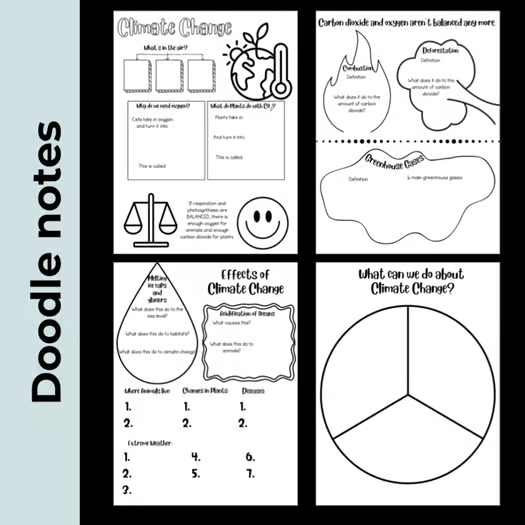
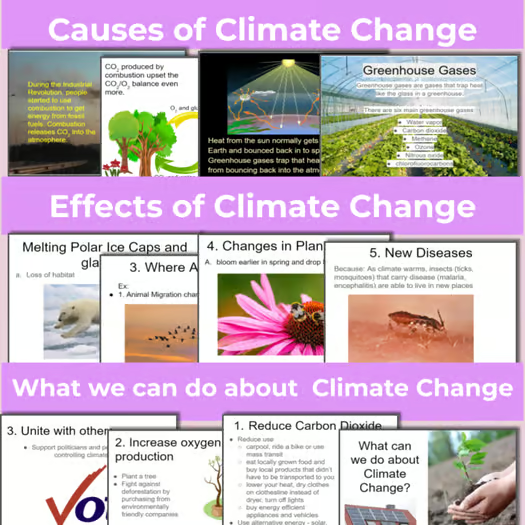
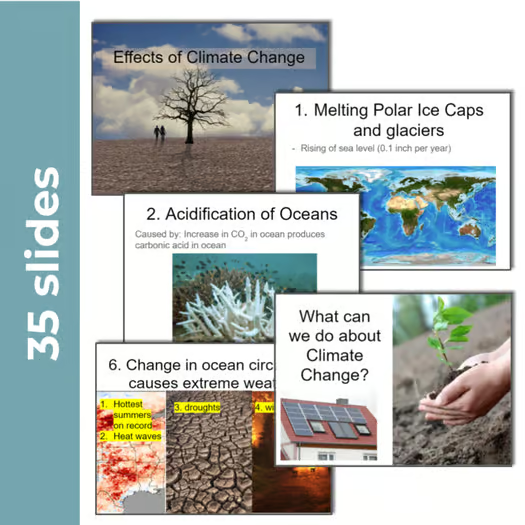
This is the perfect place to integrate free climate change slides and cloze notes.
Students explore renewable vs. nonrenewable energy sources, including solar, wind, hydroelectric, geothermal, and biomass. The free slides provide clear visuals, while the notes help students organize information.
👉 Click here to download free slides and cloze notes: https://justaddh2oschool.com/2025/05/17/kickstart-your-climate-change-unit-with-these-freebies/
Day 12: Solar and Wind Energy Hyperdocs
Students work through digital hyperdocs investigating how solar and wind energy function, their benefits, and their limitations. This inquiry-based approach supports independent learning.
Day 13: Virtual Hydroelectric Tour
Students take a virtual tour of the Hoover Dam and analyze how water can generate electricity. This lesson helps students visualize large-scale energy systems.

Day 14: Energy Sources Challenge (Project-Based Learning)
Students apply their learning by designing an energy plan for a fictional island resort. They must justify energy choices using climate and environmental data.
This project encourages collaboration, critical thinking, and communication.
Day 15: Unit Review and Assessment
Students complete a summative assessment and reflect on what they learned about climate change, evidence, impacts, and solutions.
Final Thoughts: Teaching Climate Change With Confidence
Climate change is one of the most important topics students will encounter in middle school science. With a structured, engaging approach, you can help students understand the science, analyze evidence, and explore solutions—without overwhelm.
The Climate Change 3-Week Unit for Middle School gives you everything you need: daily lesson plans, labs, activities, projects, and assessments.
👉 Explore the complete unit here:
https://www.teacherspayteachers.com/Product/Climate-Change-3-week-Unit-for-Middle-School-13554276
And don’t forget to pair it with the free climate change resources to make your unit even stronger.

Discover more from Just Add H2O
Subscribe to get the latest posts sent to your email.